The F5 Data Model
A Visual Guide to the 5-Level Structural Hierarchy
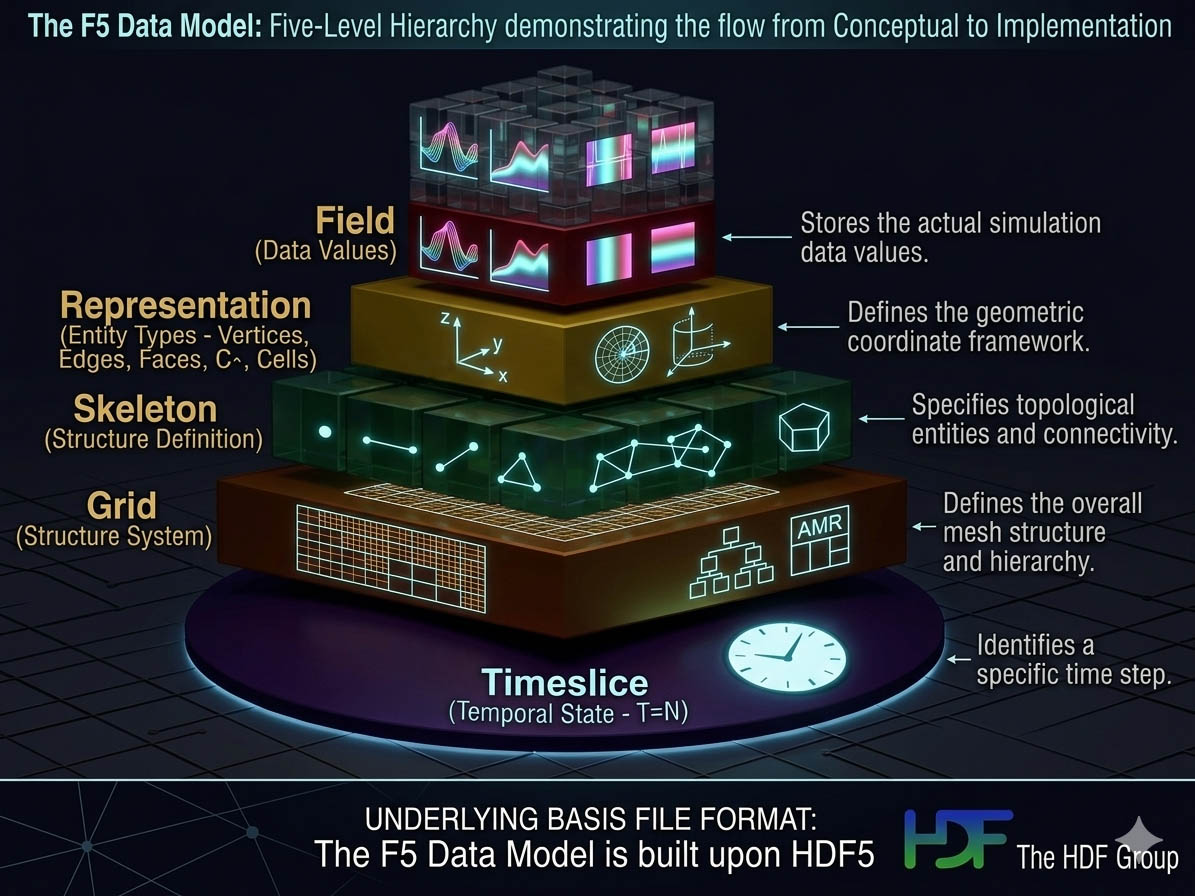
Built upon HDF5 by The HDF Group.
Explore
Hover over the pyramid layers to explore the structural levels of F5.
Topology vs. Geometry
F5 separates the connectivity of points (Topology) from their spatial coordinates (Geometry). This allows the same topology to be rendered in multiple coordinate systems simultaneously without duplicating the underlying connectivity data.
Mathematical Core
Conceptually, F5 represents a fiber bundle with total space E, where B is the base space (the grid) and F is the fiber (the value at each point):
E ≈ B × F
1. Field (The Values)
The top layer contains the actual simulation data - scalars, vectors, or tensors - mapped onto the underlying geometry. Fragmentation into chunks is optional for performance considerations such as parallel I/O, sparse domains, memory conservation.
2. Representation (The Coordinates)
Defines the coordinate system (Cartesian, Spherical, etc.). F5 allows multiple representations for the same skeleton. Representations may also be relative to another Skeleton to specify topological relationships.
3. Skeleton (The Topology)
Specifies the topological properties such as connectivity. Whether you have vertices, edges, or 3D cells, the Skeleton defines them as an index space with field specifying how they relate.
4. Grid (The Structure)
A collection of topological entities - the organizational container for skeletons. This is where geometric entities from simple point clouds, meshes or AMR (Adaptive Mesh Refinement) hierarchies are managed.
5. Timeslice (The Temporal State)
The base level. Every object in F5 exists within a specific temporal context, supporting complex multi-rate simulations.